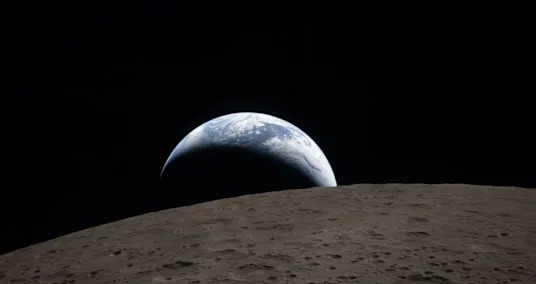
It was a moment for the history books: The Artemis II mission performed its much anticipated lunar flyby yesterday, and came within just 4,067 miles of the moon.
While soaring aboard their Orion capsule beyond the far side of the moon, the crew also reached an estimated 252,756 miles from Earth, breaking Apollo 13’s record for the farthest humans have traveled into space.
The flyby lasted seven hours, during which the astronauts could enjoy views of the lunar surface previously unseen by human eyes, with about 21% of the moon’s mysterious far side illuminated by the sun from the crew’s perspective.
Communications stopped for about 40 minutes during Orion’s transit behind the moon. The crewmembers saw Earth appear to set behind the moon, not dissimilar to what the Apollo astronauts witnessed in 1968. They were also treated to a very special solar eclipse.

After the flyby, Artemis II Commander Reid Wiseman thanked the NASA science team for putting together such an exciting observing program for them, as well as “some great, truly human experience moments here.”
“We were well prepared, and we appreciate all of you, and this is what we do best when we all come together and work as a team,” Wiseman said. “So y’all knocked it out of the park. Thank you for giving us this opportunity.”
Science officer Dr. Kelsey Young shared these comments with the crew: “I can’t say enough how much science we’ve already learned and how much inspiration you’ve provided to our entire team, the lunar science community and the entire world with what you were able to bring today. You really brought the moon closer for us today. And we cannot say thank you enough.”
The crew took thousands of photos that will help inform scientists’ understanding of the moon and its origins — and lay the groundwork for future missions to the lunar surface.
unknown content item
-
“You know from your experience of seeing the Earth from space how it just seems different,” said Canadian Space Agency astronaut Jeremy Hansen, while speaking with NASA Administrator Jared Isaacman about the flyby.
“When we were on the far side of the moon, looking back at Earth, you really felt like you weren’t in a capsule. You’d been transported to the far side of the moon. And it really just bent your mind. It was an extraordinary human experience. We’re so grateful for it.”
For more CNN news and newsletters create an account at CNN.com
NEUESTE BEITRÄGE
- 1
 Flu cases are rising with a strain that makes older people sicker01.01.2026
 - 2How much would you pay to meet a Real Housewife? At BravoCon, the limit does not exist.21.11.2025
- 3Israel Police decry online defamation campaign against female officer in Jerusalem04.04.2026
- 4Pick Your Favored kind of soup06.06.2024
- 5Qantas and Virgin Australia Ban Power Bank Usage on Flights Following Safety Incidents24.11.2025





Ähnliche Artikel
- The Effect of Online Organizations on Society: Beating the Difficulties30.06.2023
- 5 Instructive Toy Brands for Youngsters05.06.2024
- One third of Spanish pork export certificates blocked since swine fever outbreak, minister says29.11.2025
- Chicago reports first rabies-positive dog in 61 years. What we know.24.12.2025
- Israel’s mixed messaging on Christmas draws controversy25.12.2025
- Israeli president concerned over proposed renaming of park29.11.2025
- Dental, Vision, and Hearing Inclusion in Senior Protection.19.10.2023
- Over 250,000 cases of shredded cheese recalled over possible metal fragments03.12.2025
- The race is on to turn your body into a GLP-1 factory04.11.2025
- $2,000 tariff rebate checks? 50-year mortgages? Making sense of Trump's new 'affordability' proposals.12.11.2025


