By Will Dunham
WASHINGTON, April 2 (Reuters) - A remarkable assemblage of fossils from China is revealing that animal life diversified in Earth's primordial seas millions of years earlier than previously known, with an array of forms including ancient members of a group that eventually led to vertebrates including humans.
Paleontologists unearthed some 700 fossils of individual small soft-bodied animals that lived roughly 546 to 539 million years ago during the Ediacaran Period, depicting a dramatic transformation in animal life as it occurred. Many of them are weird and barely recognizable as animals to the untrained eye.
The fossils, discovered in China's Yunnan Province, are known collectively as the Jiangchuan Biota. They are in a form called a carbonaceous film, a dark and two-dimensional layer of carbon left behind after an organism is compressed during the fossilization process. This preserved anatomical details such as guts as well as feeding and locomotion structures.
The discovery is particularly significant because it shows a rapid diversification of animal life already unfolding during the Ediacaran, predating the well-known burst of evolutionary innovation that occurred during the subsequent Cambrian Period. By the end of this Cambrian Explosion, early members of most broad animal groups alive today had appeared.
"We found a fossil site which gives us new information about the rise of complex animal life, before the Cambrian Explosion. We found evidence of animal groups that are otherwise found only about 520 million years ago - after the peak of the Cambrian Explosion - existing in the late Ediacaran Period, more than 20 million years earlier," said paleontologist Frankie Dunn of the University of Oxford, one of the authors of the research published on Thursday in the journal Science.
During the Ediacaran, Earth was a much different place than today. The planet was coming out of a profound global icehouse state called Snowball Earth, the continents were in very different positions, and atmospheric oxygen levels were much lower.
In the midst of all this, the first animal life was appearing in the seas. The earliest-known undisputed fossils of animals date to about 574 million years ago, with creatures that resemble fern fronds or feathers. Other Ediacaran animals previously known included sponges and cnidarians, the group spanning jellyfish and corals.
"If you were to peer back into the Cambrian, you would be able to recognize much of the animal life around you, but this is not the case during the Ediacaran, where recognizable animals would likely be few and far between. Our new site shows a world in transition, moving into the complex animal-dominated world we see around us today," Dunn said.
Among the Jiangchuan Biota fossils, researchers discovered the most ancient members yet found of an expansive group called deuterostomes. That is noteworthy because vertebrates - including humans - are deuterostomes, though anatomically vastly different than the ones inhabiting the Ediacaran seas.
The Jiangchuan Biota fossils included bilaterian animals, those possessing bodies that can be divided into equal halves. Most animals today are bilaterian but it was revolutionary during the Ediacaran.
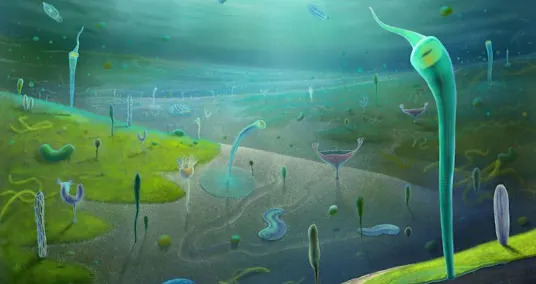
The fossils included animals with a U-shaped body that lived attached to the seafloor with a stalk and displayed a pair of tentacles on the head used to catch food. They were early members of the animal group that contains today's starfish and acorn worms.
There also was a creature the researchers called the bugle worm because of its vague resemblance to that musical instrument, with a wormy body attached to the seafloor and a proboscis that could turn inside out.
"When we were collecting fossils in the field, we were all surprised by how diverse the fauna was and how abundant the fossils were," Dunn said.
"We expected to see more and more evidence of animals in the Ediacaran, but animals like the bugle worm tell us that not all of these will be forms that we could predict from the living diversity of animal life or even from the Cambrian Explosion," Dunn said. "This tells us that there is still a lot to learn about the radiation of animal life and the nature of the transition from the Ediacaran to the Cambrian."
(Reporting by Will Dunham in Washington, Editing by Rosalba O'Brien)
NEUESTE BEITRÄGE
- 1
 As tetanus vaccination rates decline, doctors worry about rising case numbers24.12.2025
 - 2Which '80s Film Actually Holds Up Today?01.01.1
- 3Virtual reality opens doors for older people to build closer connections in real life24.12.2025
- 4James Webb Space telescope spots 'big red dot' in the ancient universe: A ravenous supermassive black hole named 'BiRD'04.11.2025
- 5Dental, Vision, and Hearing Inclusion in Senior Protection.19.10.2023


Ähnliche Artikel
- The Force of Positive Reasoning: Day to day Attestations01.01.1
- Here are 10 stores where you can get a free Thanksgiving turkey17.11.2025
- Ski Resorts Universally: A Colder time of year Wonderland Guide06.06.2024
- Paul Feig loves a plot twist. Why not reboot 'Die Hard' starring a woman?19.12.2025
- IDF strikes Hamas terror cell operating near Israeli troops in northern Gaza03.04.2026
- 10 Hints for an Effective New employee screening25.09.2023
- Manual for Instructive Application for Youngsters01.01.1
- Interstellar comet 3I/ATLAS will fly by Earth Friday. Here are the latest images19.12.2025
- Major Scottish gangland figure Steven Lyons arrested in Bali28.03.2026
- Vote In favor of Your Favored IT Administration05.06.2024