When you buy through links on our articles, Future and its syndication partners may earn a commission.

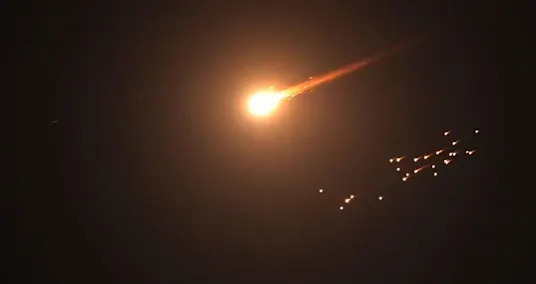
You can tune in to see live views of the Geminid meteor shower as it peaks overnight on Dec. 13-14, thanks to a free livestream hosted by the Virtual Telescope Project. The annual shower occurs as Earth passes through the debris-strewn orbit of the wandering asteroid (3200) Phaethon.
The livestream is scheduled to start at 4 p.m. EST (2100 GMT) on Dec. 13 on The Virtual Telescope Project's YouTube channel, weather permitting. Under perfect dark-sky conditions, you could see up to 150 meteors per hour near the peak, although most viewers will see fewer, especially from light-polluted areas.
If clouds conspire to ruin your view — or if you live in the southern hemisphere, where the shower isn't visible at all — the Virtual Telescope Project's Livestream will help ensure that you won't miss out on one of the most impressive natural light shows of the year.
The stream is set to run until dawn and will feature views from the organization's super-wide-angle all-sky camera located in Manciano, Italy, which, according to Virtual Telescope Project founder Gianluca Masi, is one of the darkest sky regions in the country.
How to look for Geminids
Look for Geminid meteors streaking away from a point of origin close to the bright star Castor in the constellation Gemini, which rises above the eastern horizon a few hours after sunset and remains visible throughout the night. As such, Geminid shooting stars can be spotted from mid-evening until dawn. Moonlight shouldn't spoil the show too badly this year, though a 26%-lit waning crescent moon rises an hour or two after midnight, which may make viewing slightly more challenging in the hours preceding sunrise.
Shooting stars become visible when particles shed by wandering comets or asteroids impact Earth's atmosphere and vaporize in brief flashes of light., If you're hoping to capture a photo of a meteor yourself, check out our guide to photographing shooting stars, along with our picks of the best cameras and lenses for imaging the night sky.
Editor's Note: If you capture a shooting star and want to share your astrophotography with Space.com's readers, then please send your photo(s), comments, name and location to [email protected].
NEUESTE BEITRÄGE
- 1
 The Main 15 Applications for Efficiency and Association07.07.2023
 - 2Starship success, a private moon landing and more: The top 10 spaceflight stories of 202521.12.2025
- 3The most effective method to Beat Dental Tension and Guarantee Customary Exams19.10.2023
- 4Full Supreme Court to hear challenge to Judicial Selection Committee law02.12.2025
- 5Boeing's troubled capsule won't carry astronauts on next space station flight24.11.2025



Ähnliche Artikel
- Ford Is Using a Chinese-Built Van to Fight Europe’s EV Price War28.03.2026
- Scientists are getting our robotic explorers ready to help send humans to Mars31.12.2025
- Twins were the norm for our ancient primate ancestors − one baby at a time had evolutionary advantages13.12.2025
- Becoming amazing at Systems administration: Individual and Expert Tips01.01.1
- Flourishing in Retirement: Individual Accounts of Post-Profession Satisfaction11.08.2023
- Make your choice for a definitive Christmas getaway destination!17.10.2023
- Israel and Iran continue tit-for-tat attacks29.03.2026
- Figure out How to Streamline Your Profits in Gold Speculation19.10.2023
- Spanish bishops and government sign deal for compensation of church sexual abuse victims30.03.2026
- Little Italy Mercato brings fresh food and community to downtown San Diego04.04.2026