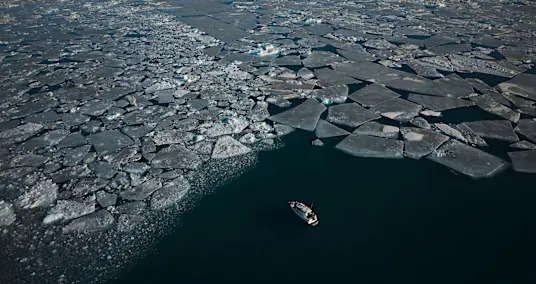
If you were traversing the ancient Tethys ocean some 115 million years ago and encountered gigantic lamniform sharks, you’d most definitely need a bigger boat.
Lamniformes, an order of sharks that includes the great white of Jaws infamy, evolved around 135 million years ago and may have begun as wee, shallow water-dwelling creatures—around 3 feet long. But over time, they evolved into massive, fearsome fish that ruled the world’s oceans, for example the extinct megalodon that might have surpassed 50 feet long.
Previous evidence suggested that lamniformes swelled in size to hit the top of the marine food chain around 100 million years ago. Now, fossilized vertebrae found in Australia push this timeline back some 15 million years. These vertebrae appear to have belonged to a type of lamniform called a cardabiodontid, a hefty mega-predatory shark that swam among huge marine reptile neighbors such as plesiosaurs and ichthyosaurs while dinosaurs roamed land.

This ancient ocean beast weighed more than 3 tons and measured between around 20 and 26 feet long, scientists reported in Communications Biology. According to statistical analysis of data from almost 2,000 modern sharks, the authors suggest that this ancient shark ballooned in size relatively early in its evolutionary history, about 20 million years after lamniformes emerged.
“This discovery changes the timeline for when sharks started getting really big,” said study author Mikael Siversson, a paleontologist at the Western Australian Museum, in a statement. “It turns out, they evolved a giant body size much earlier than we originally thought and were already top predators in shallow seas.”
Read more: “You’re Going to Need a Bigger Light”
The cardabiodontid vertebrae were discovered at a dig site called the Darwin Formation in northern Australia, which was once part of a shallow shelf bordering the Tethys ocean that sat between modern-day Australia and Europe. The same site has also revealed ancient marine reptiles, ray-finned fish, and other types of sharks.
The shark fossils were a rare find: Their skeletons are made of rubbery cartilage and don’t tend to stick around, so most known shark remnants are teeth. But these vertebrae were partially mineralized, keeping them relatively well preserved over the millennia.
Overall, the recent cardabiodontid findings reveal “a lot about how ancient food webs worked” Siversson said, and show “just how important Australia’s fossil sites are for understanding prehistoric life.”
Enjoying Nautilus? Subscribe to our free newsletter.
Lead image: Polyanna von Knorring, Swedish Museum of Natural History
This story was originally featured on Nautilus.
NEUESTE BEITRÄGE
- 1
 Opening Innovativeness: Moving Thoughts and Tasks01.01.1
 - 2Scientists Just Discovered Japan’s First New Bird Species in Over 40 Years29.03.2026
- 3Venezuelans in Madrid celebrate Maduro's capture03.01.2026
- 4Syrian army says recent drone attacks targeted its bases near Iraq, most shot down30.03.2026
- 5Latvia seeks emergency UN meeting over Russian missile attack on Lviv09.01.2026





Ähnliche Artikel
- Vote in favor of the handheld vacuum that you love for its strong attractions!07.06.2024
- 5 Family SUVs for 2024: Which One Accommodates Your Family's Needs\uff1f05.06.2024
- Holiday season sees uptick in norovirus cases, according to CDC26.11.2025
- They relied on marijuana to get through the day. But then days felt impossible without it25.11.2025
- Arctic sea ice hits lowest winter level as unprecedented heat hits smashes records all over Earth27.03.2026
- Figure out How to Advance Space in Your Pre-assembled Home for Upgraded Usefulness19.10.2023
- Indian rocket launches record-breaking BlueBird 6 smartphone satellite to orbit (video)23.12.2025
- Israeli tourist data from 2025 misrepresented as mass exodus to Thailand29.03.2026
- Building an Individual Brand: Illustrations from Powerhouses25.09.2023
- The Best Computer games Ever06.07.2023