NEW YORK (AP) — Using the oldest dog genes studied so far, scientists are finding more evidence that our furry friends have been our companions for thousands of years.
Scientists think dogs descended from an ancient population of gray wolves somewhere in Europe or Asia. Tens of thousands of years ago, those wolves got used to living with people and became less aggressive. As they became domesticated, their genes shifted along with their behavior, giving rise to the pups we know today.
But exactly when and where this happened remains a mystery. Scientists are studying bits of DNA found in ancient dog and wolf remains to figure out what the earliest dogs may have looked like and where they came from.
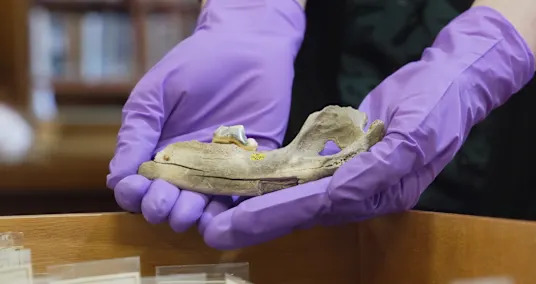
In two separate studies published Wednesday in the journal Nature, researchers pushed the timeline back. They established a new way to study ancient canine DNA — which is often contaminated and tough to extract — by isolating just the doggy bits.
They examined ancient genes from the remains of over 200 dogs and wolves. The oldest dated back to about 15,800 years ago, moving the origin of dogs back by at least 5,000 years.
“This unique relationship between people and dogs has existed for such a long time and is continuing on today,” said University of Michigan dog genomics expert Jeffrey Kidd, who was not involved with the new research.
The genes showed that dogs were already spread out across Western Europe and Asia 14,200 years ago, at a time before agriculture and farming. These dogs lived with hunter-gatherer humans who were constantly on the move.
The dawn of agriculture — a major shift in human history — brought new people to Europe from southwest Asia. They mixed and mingled with Europeans, leaving a lasting and varied imprint on their genes.
But the dog genes studied by the scientists, stretching from the United Kingdom all the way to Turkey, stayed more consistent. They were less impacted by the arrival of new humans during the development of agriculture, and more by interactions between different hunter-gatherer groups and their dogs thousands of years before.
That's different from dogs in Asia and the Americas, whose genes more closely reflect the movement patterns of their owners.
Scientists don't know exactly what the first dogs looked like, but they have some ideas.
“We're suspecting they would have resembled smaller wolves,” said study co-author Lachie Scarsbrook with the Ludwig Maximilian University of Munich.
It's also not clear how these ancient dogs lived alongside their humans. They could have stood guard or helped them hunt, but probably also played with young children.
There's still more work to go to pinpoint exactly when dogs emerged — the first few pages of a storied relationship that's still going strong.
“They are humanity's best friend, alongside our societies for the last 16,000 years and will continue to in the future,” Scarsbrook said.
___
The Associated Press Health and Science Department receives support from the Howard Hughes Medical Institute’s Department of Science Education and the Robert Wood Johnson Foundation. The AP is solely responsible for all content.
NEUESTE BEITRÄGE
- 1
 Apollo vs. Artemis: What to know about NASA's return to the moon29.03.2026
- 24 Family SUVs: Joining Solace and Style05.06.2024
- 37 Logically Demonstrated Techniques for Better Rest11.08.2023
- 4The Best 15 Applications for Efficiency and Association07.07.2023
- 5EU waters down plans to end new petrol and diesel car sales by 203516.12.2025





Ähnliche Artikel
- Who was Haytham Ali Tabatabai, Hezbollah's military leader killed by Israel?23.11.2025
- Pick Your #1 Kind Of Bread05.06.2024
- Step by step instructions to Explore the Close to home Consequence of Cellular breakdown in the lungs17.10.2023
- Uzbekistan launches €9.46 billion green energy push, covering nation’s power needs05.12.2025
- Electric Vehicles for Eco-Accommodating Driving06.06.2024
- German men need approval for stays abroad under military service law04.04.2026
- Sexual violence is being used as a weapon in Sudan's war, doctors group says31.03.2026
- Tickets for 'Stranger Things' Season 5 finale, to be shown in movie theaters on New Year's Eve, go on sale today. Here's how you can save your seat.02.12.2025
- Artemis II updates: NASA's moon mission breaks Apollo record for farthest distance humans have traveled from Earth06.04.2026
- NASA releases new ‘Earthset’ and eclipse images taken during historic flyby of the moon07.04.2026